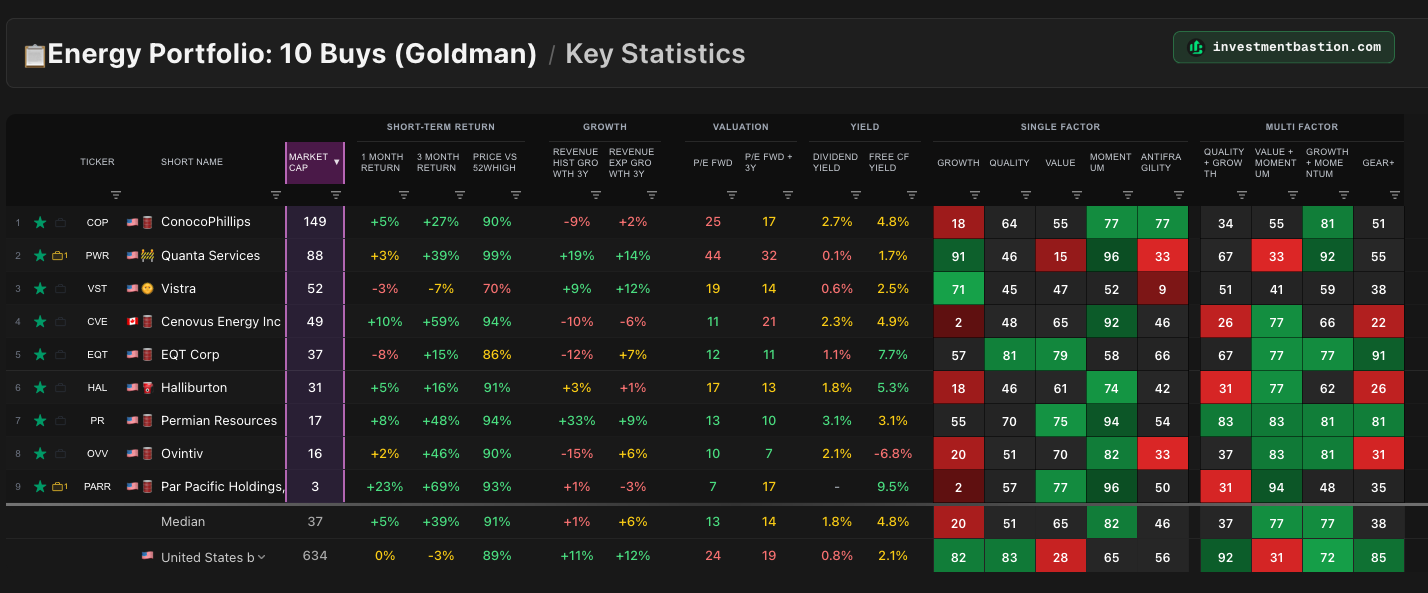
Energy Portfolio Strategy: 10 Buys With Above-Average Upside (Goldman)
1. Par Pacific $PARR Refiner operating in the US West Coast where fuel supply is structurally tight due to limited competition. This gives the company pricing power that most refiners don't have. On top of that, PARR may get regulatory credits (SREs) that would cover ~70% of its environmental obligations, saving significant cash. Management is using the strong balance sheet to buy back shares aggressively.
2. ConocoPhillips $COP One of the largest independent oil producers in the world. Several major projects, including Willow in Alaska (already ~50% complete), are about to come online, which should drive 20-25% annual cash flow growth per share through 2030. The company also has over 20 years of low-cost drilling inventory, ensuring it can sustain production for decades.
3. Cenovus Energy $CVE (Cenovus Energy) Canadian oil sands producer preparing to launch the West White Rose offshore project, which will significantly boost production volumes. Recently acquired MEG Energy and expects to squeeze out C$400M/year in cost savings by 2028. Long-life assets with minimal geopolitical risk compared to peers operating in the Middle East or Africa.
4. Ovintiv $OVV Recently reshaped its portfolio through a smart swap: sold lower-quality Anadarko assets for $2.85B and acquired NuVista to double down on the Permian and Montney basins. Now sits on 15-20 years of drilling inventory. Despite a 44% rally this year, the stock still trades at a 15% free cash flow yield, meaningfully cheaper than peers at 12%.
5. Permian Resources $PR A pure-play Delaware Basin operator laser-focused on getting more oil out of the ground for less money. The company has a track record of bolt-on acquisitions that keep scaling the business. Capital allocation is balanced across dividends, buybacks, acquisitions, and debt reduction. Trades at the same attractive 15% FCF yield discount as OVV.
6. EQT Corp $EQT The dominant low-cost natural gas producer in the Appalachian Basin. Vertical integration (owning its own pipelines) keeps costs below peers, meaning EQT makes more money per unit of gas produced through the entire price cycle. As LNG export capacity grows and power plants switch from coal to gas, demand for US natural gas is set to rise structurally.
7. Golar LNG $GLNG Operates floating LNG liquefaction plants, essentially ships that convert gas into exportable LNG right at the source. EBITDA is expected to grow from ~$260M in 2025 to ~$800M by 2028. A 4th and 5th vessel could add another 50%+ to earnings. The company has also launched a strategic review that could lead to a sale, providing a potential M&A premium.
8. Halliburton $HAL Oilfield services giant with a roughly 40/60 split between North America and international markets. This balance is an advantage right now: peers overexposed to international markets face geopolitical risk, while those too focused on North America face activity slowdowns. HAL also has a ~20% stake in VoltaGrid, giving it exposure to the booming behind-the-meter power generation market.
9. Quanta Services $PWR The largest specialty contractor building out America's power grid. As AI data centers, electric vehicles, and electrification drive massive new power demand, someone has to physically build the transmission lines. Quanta is that company. EPS is expected to grow ~17% annually through 2030, with further upside as construction of high-voltage 765kV lines begins in 2027-28.
10. Vistra Corp $VST Owns 3.8 GW of nuclear capacity already locked into long-term power purchase agreements, with another ~3.2 GW of contracting opportunities ahead. Recently signed a PPA with Meta. Management sees a path to ~25% annual cash flow growth as more of the fleet gets contracted. The stock is down 6% YTD on AI/power demand fears, creating an entry point. Goldman sees 38% upside, the highest in the list.